

CONTEXT
The task: find, validate, and build an idea from scratch in 8 weeks.
Though I was the sole designer working alongside one PM and two developers, we were collectively responsible for being founders first: for the first few weeks of our incubator program, we conducted countless customer discovery calls across industries ranging from fashion manufacturing to Web3 finance to equine. Through simple brute force, we developed a product sense guided by instinct, feasibility, and outreach.
Is xyz a real pain point, or is it a solution in search of a problem?
THE PROBLEM
Livestock animals like horses are prone to common illnesses that escalate overnight, but no one's watching their animals 24/7.
With my PM having extensive experience in the equine industry, we identified a real, pressing problem barn managers and horse owners share: horses who are ill easily slip under the radar until it's too late. If symptoms escalate too far, barn managers are left with wildly expensive medical bills at best (~$15,000) and compromised animal livelihood at worst.
Colic (abdominal pain) accounts for 28% of all horse deaths
The earliest signs show up hours before a crisis
Surgery runs caretakers tens of thousands of $$$
In a rush? Fast-forward to what we built here!
THE PROCESS
After deciding on our problem space following initial stakeholder interviews, we began ideating on potential form factors to detect early signs of distress.
Early concepts took the form of a wearable attached to the animal's leg:

FIGURE 02
Visual demonstration of Valkyrie v.1
Spikes in body temperature is a common sign of inflammation and potential illness. In this iteration, the wearable has embedded thermal sensors to track the body's internal temperature. Detected rapid increases in temperature would be pushed to the user's phone via app notification.
V.1 was ultimately rejected after further discussion with primary stakeholders.
After interviewing and consulting with barn managers, vets, and equestrians, the wearable form was scrapped due to its unreliability: the hardware was prone to breaking during movement, as seen from existing wearables from the market. The end goal being a preventative device, this risk was too significant for our team to move forward.

FIGURE 03
Visual demonstration of Valkyrie v.1 [REJECTED]
As a result, we went back to the drawing board and identified key criteria for solutions moving forward:
Sturdy/durable
Easy to use and integrate with stakeholders' existing tools
Reliable and effective preventative functionality
BEHIND THE DESIGN
With our solution's form factor approved, I started pushing pixels.

FIGURE 04
To start, our team put together a spec sheet of Valkyrie's essential functions. Afterward, I took to pen and paper to develop initial wireframes as I experimented with the UI and user journey.
DESIGN DECISION SPOTLIGHT
While our team was writing up the feature spec, we included the idea of users being able to see a numerical "risk score" to indicate their animals' status:

FIGURE 05
The beginnings of the "risk score" concept in our spec.
However, because our end users were primarily barn managers who needed a reliable, clear way to understand their animals' health status, I ultimately pushed back on the numerical format: one, because it implied a precision our data couldn't support, and two, because it forced users to interpret the value on an arbitrary scale.

FIGURE 06
Iterating on the initial UX by keeping core user needs in mind.
Instead, I proposed a much simpler three-variant status bar that not only used color to indicate severity, but also communicated each animal's status in a way that required no extra interpretation. This way, our data processing was contained within the backend and could be funneled into a clear result.


FIGURE 07-08
My proposed fix for the UI, delivering the necessary status information as clearly as possible by using tags instead of numerical values.
OUR SOLUTION
A stall monitor that analyzes your animal's behavior around the clock.
Valkyrie comes in two parts: a camera in-stall and a mobile app. Using computer vision and AI to analyze the animal's body language around the clock, Valkyrie detects symptoms using research-backed behavioral models.
When something looks wrong, users are alerted immediately through our mobile app, and can view live footage or request emergency veterinary care directly from the platform.

FIGURE 09
Valkyrie's UI
WATCH LEVEL
Barn managers set their preferred Watch Level, which calibrates how sensitive Valkyrie is to changes in behavior. For more at-risk animals or cautious managers, an adjustable threshold is meant to put their mind at ease.


INSTANT VISIBILITY
Alerts are sent to the user's device as soon as Valkyrie flags something in the animal's behavior, keeping them in the loop at all times and allowing them to take action early on.
RESOLVE ALERTS
Check in right from the app. Allowing users to dismiss alerts by resolving serves two functions: keeps the warning persistent until addressed, and gives them a way to document their livestocks' medical history and general behavior.

How Valkyrie addresses our key criteria:
THE RESULT
Won Judge's Choice - then collaborated with the Ring team to ship Valkyrie.
After our win on Demo Day, Jamie Siminoff, founder of Ring and one of the judges who had watched our pitch, connected us to the Ring and Amazon teams to ship Valkyrie on their new community-powered Ring App Store platform!
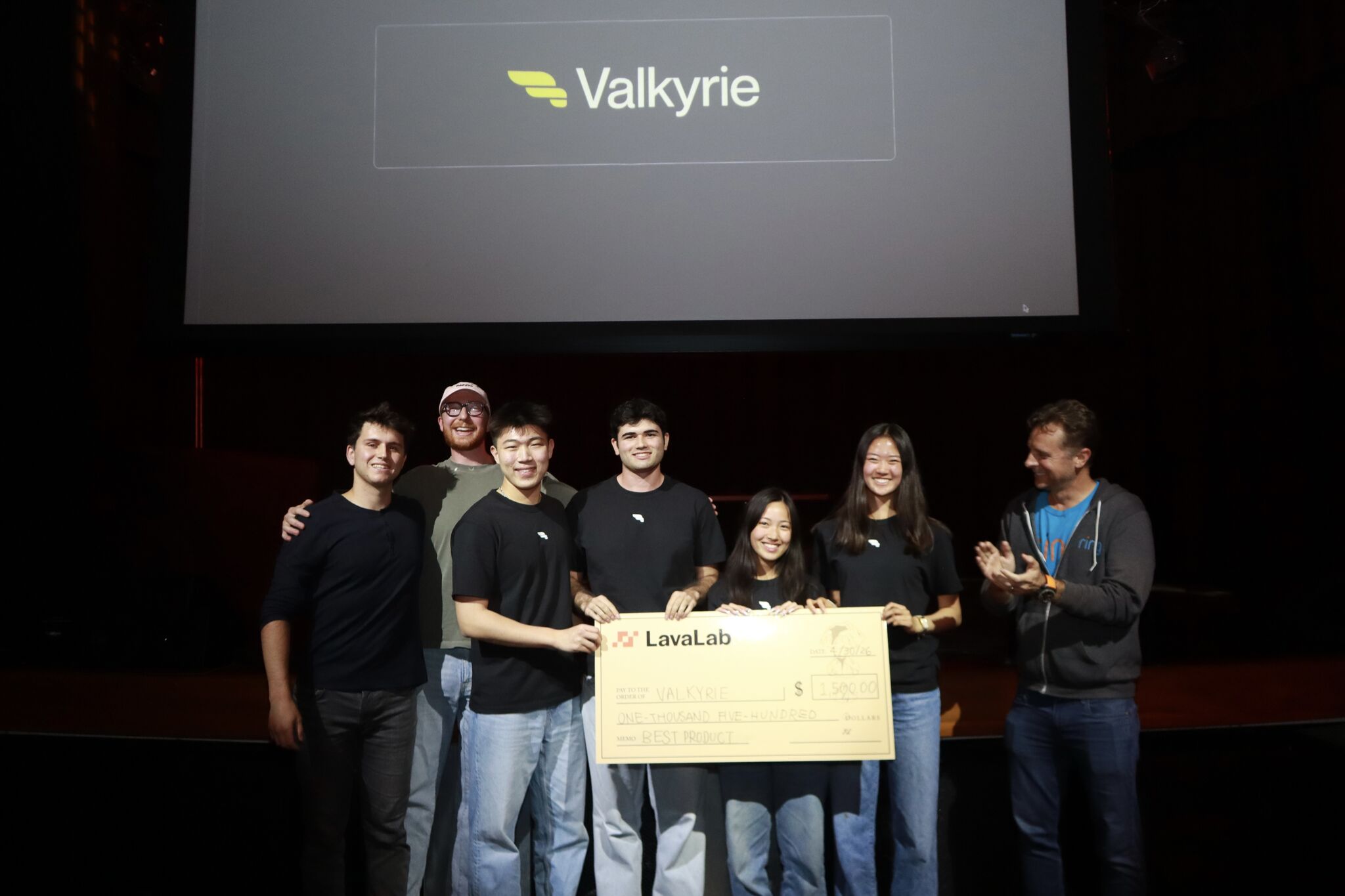
FIGURE 10
My team and I with the judges, taking home Judge's Choice on Demo Day!
FIGURE 11
My deck for our pitch, made entirely in Figma
TAKEAWAYS
What I learned after Valkyrie
User research is the not-so-secret sauce
Valkyrie's design process was incredibly non-linear: it was thanks to conversations with barn managers and equestrian friends that allowed us to land on a solution that actually delivered value without the fluff.
Simplicity is a decision, not a shortcut
While designing Valkyrie, I learned to make deliberate choices for the UI to meet user needs, rather than choose the most "precise" option every time. Oftentimes, what I initially believed to be the better, more rigorous option only meant more heavylifting from the user.

FIGURE 11
Our team visiting a local barn to set up Valkyrie for the first time!